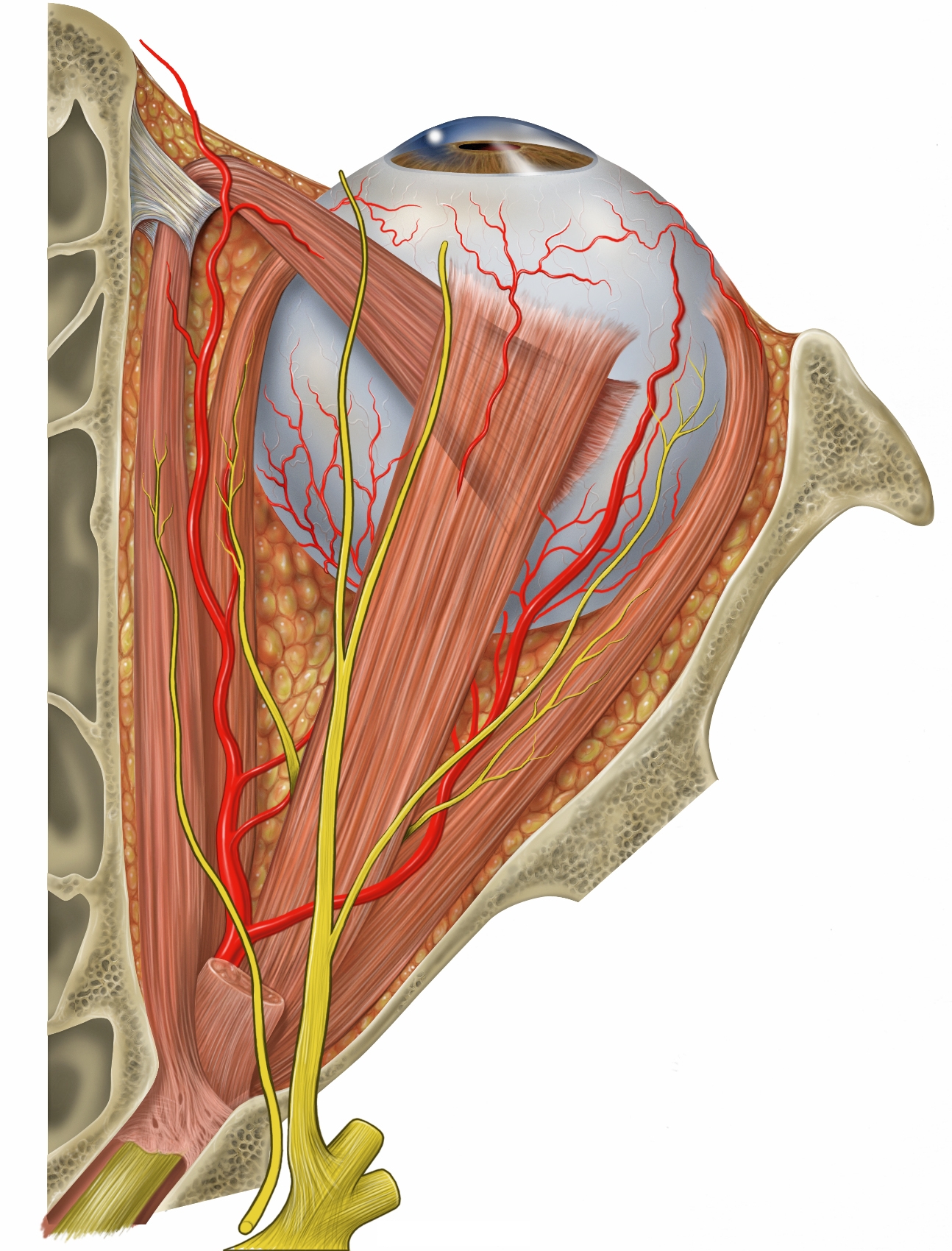
enclosed in a socket, or orbit, which is made up of portions
of several of the bones of the skull to form a four-sided
pyramid the apex of which points back into the head.
Thus, the floor of the orbit is made up of parts of the maxilla,
zygomatic, and palatine bones, while the roof is made
up of the orbital plate of the frontal bone and, behind this,
by the lesser wing of the sphenoid. The optic foramen, the opening through which the optic nerve runs back into the
brain and the large ophthalmic artery enters the orbit, is
at the nasal side of the apex; the superior orbital fissure is
a larger hole through which pass large veins and nerves.
These nerves may carry nonvisual sensory messages—e.g.,
pain—or they may be motor nerves controlling the muscles
of the eye. There are other fissures and canals
transmitting nerves and blood vessels. The eyeball and its
functional muscles are surrounded by a layer of orbital fat
that acts much like a cushion, permitting a smooth rotation
of the eyeball about a virtually fixed point, the centre
of rotation. The protrusion of the eyeballs—proptosis—
in exophthalmic goitre is caused by the collection of
fluid in the orbital fatty tissue.

Hiç yorum yok:
Yorum Gönder