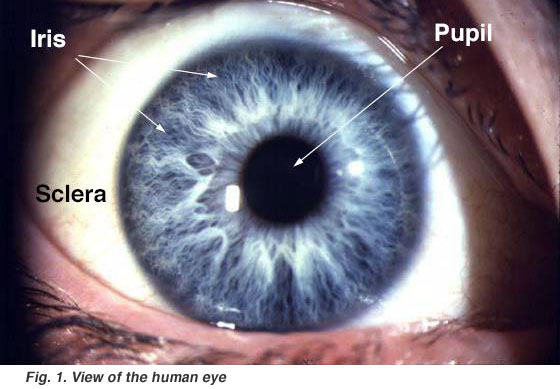
the only portion that is visible to superficial inspection,
appearing as a perforated disc, the central perforation, or
pupil, varying in size according to the surrounding illumination
and other factors. A prominent feature is the
collarette at the inner edge, representing the place of
attachment of the embryonic pupillary membrane that, in
embryonic life, covers the pupil. As with the ciliary body,
with which it is anatomically continuous, the iris consists
of several layers: namely, an anterior layer of endothelium,
the stroma; and the posterior iris epithelium. The stroma
contains the blood vessels and the two sheets of smoothmuscle, the sphincter and dilator muscles, that control the
contraction (constriction) and the expansion (dilation) of
the iris, respectively. In addition, the stroma contains pigment
cells that determine the colour of the eye.
Posteriorly, the stroma is covered by a double layer of
epithelium, the continuation forward of the ciliary epithelium;
here, however, both layers are heavily pigmented
and serve to prevent light from passing through the iris
tissue, confining the optical pathway to the pupil. The
pink iris of the albino is the result of the absence of pigment
in these layers. The cells of the anterior layer of the
iris epithelium have projections that become the fibres of
the dilator muscle; these projections run radially, so that
when they contract they pull the iris into folds and widen
the pupil; by contrast, the fibres of the sphincter pupillae
muscle run in a circle around the pupil, so that when they
contract the pupil becomes smaller. By controlling the
size of the pupil, these muscles determine how much light
reaches the sensory tissue of the retina, which is important
for optimal vision. Thus, in bright light, the sphincter
muscle constricts, whereas in low light or darkness, the
dilator muscle expands the opening.
Eyes that are the colour blue may result from
decreased amounts of pigment in the stroma; the light
reflected back from the posterior epithelium, which is
blue because of scattering and selective absorption,
passes through the stroma to the eye of the observer.
As time goes on, pigment may be deposited, and the
colour may change; thus, if much pigment is laid down
the eye becomes brown or black, if little, it remains
blue or gray.

Hiç yorum yok:
Yorum Gönder