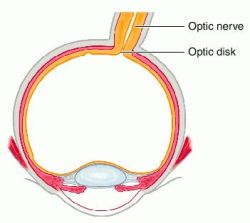
small region within the retina in which there are no photoreceptors
(i.e., rods or cones); thus there is no image
detection in this area. The optic disk corresponds to the
blind spot in the visual field of each eye. The blind spot of
the right eye is located to the right of the centre of vision
and vice versa in the left eye. With both eyes open, the blind spots are not perceived because the visual fields
of the two eyes overlap. Indeed, even with one eye closed,
the blind spot can be difficult to detect subjectively
because of the ability of the brain to “fill in” or ignore the
missing portion of the image.
The optic disk can be seen in the back of the eye with
an ophthalmoscope. It is located on the nasal side of the
macula lutea, is oval in shape, and is approximately 1.5 mm
(0.06 inch) in diameter. It is also the entry point into the
eye for major blood vessels that serve the retina. The optic
disk represents the beginning of the optic nerve (second
cranial nerve) and the point where axons from over one
million retinal ganglion cells coalesce. Clinical evaluation
of the optic nerve head is critical in the diagnosis and
monitoring of glaucoma and other optic neuropathies
that may lead to vision loss.

Hiç yorum yok:
Yorum Gönder