31 Ağustos 2010 Salı

Eyelids

It is vitally important that the front surface of the eyeball,
the cornea, remain moist. This is achieved by the eyelids,
which during waking hours sweep the secretions of the
lacrimal apparatus and other glands over the surface at
regular intervals and which during sleep cover the eyes
and prevent evaporation. Maintaining moisture levels is
vital for the normal functioning of the conjunctiva and
cornea. The conjunctiva is the mucous membrane that
lines the eyelid and covers the visible portion of the eyeball
except the cornea.


Orbit

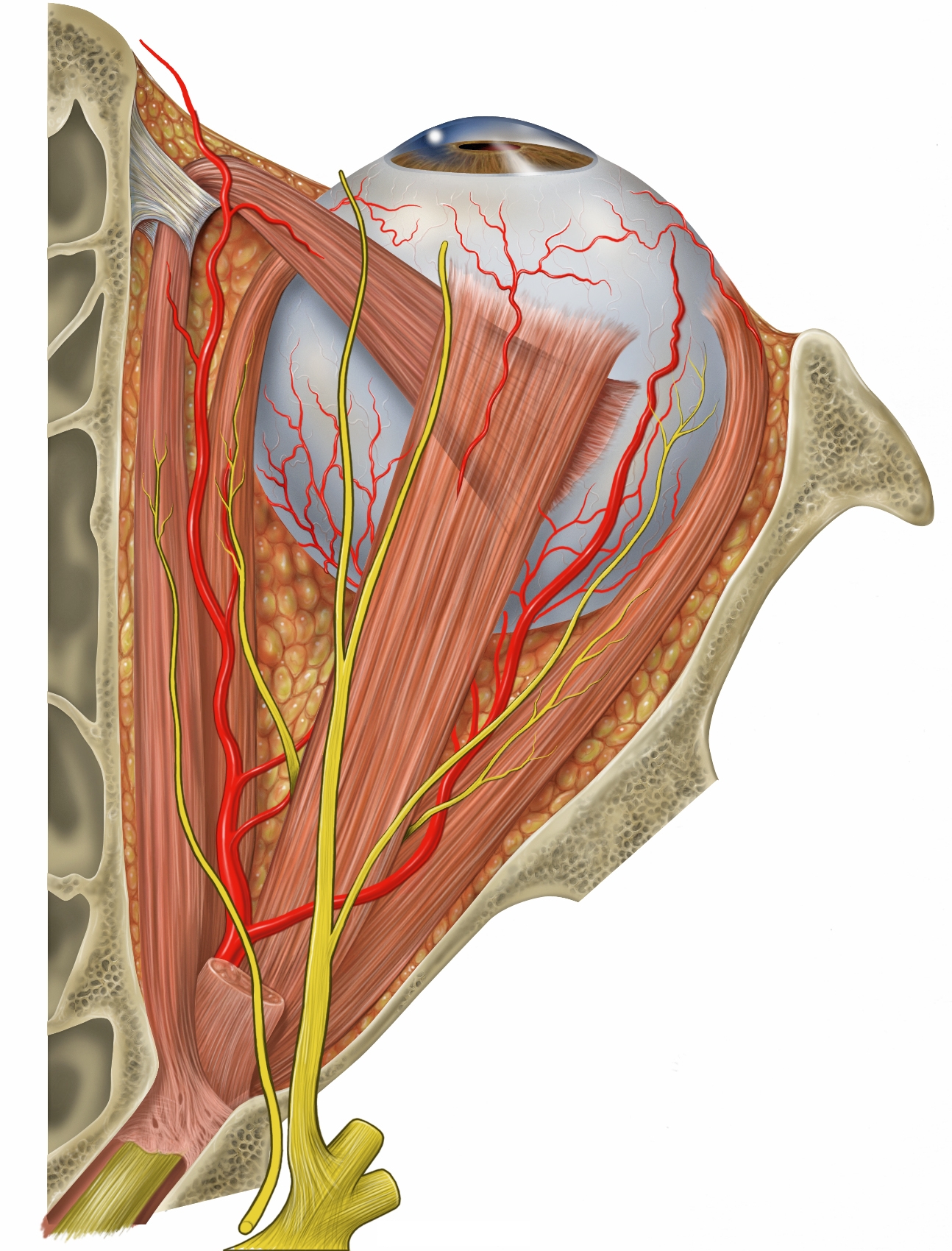
The eye is protected from mechanical injury by being
enclosed in a socket, or orbit, which is made up of portions
of several of the bones of the skull to form a four-sided
pyramid the apex of which points back into the head.
Thus, the floor of the orbit is made up of parts of the maxilla,
zygomatic, and palatine bones, while the roof is made
up of the orbital plate of the frontal bone and, behind this,
by the lesser wing of the sphenoid. The optic foramen, the opening through which the optic nerve runs back into the
brain and the large ophthalmic artery enters the orbit, is
at the nasal side of the apex; the superior orbital fissure is
a larger hole through which pass large veins and nerves.
These nerves may carry nonvisual sensory messages—e.g.,
pain—or they may be motor nerves controlling the muscles
of the eye. There are other fissures and canals
transmitting nerves and blood vessels. The eyeball and its
functional muscles are surrounded by a layer of orbital fat
that acts much like a cushion, permitting a smooth rotation
of the eyeball about a virtually fixed point, the centre
of rotation. The protrusion of the eyeballs—proptosis—
in exophthalmic goitre is caused by the collection of
fluid in the orbital fatty tissue.

Optic Nerve

The optic nerve is the second cranial nerve, which carries
sensory nerve impulses from the more than one million
ganglion cells of the retina toward the visual centres in the
brain. The vast majority of optic nerve fibres convey information
regarding central vision.
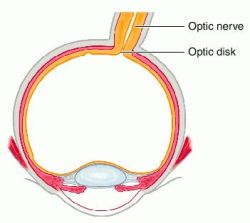
The optic nerve begins at the optic disk at the back
of the eye. The optic disk forms from the convergence of
ganglion cell output fibres (called axons) as they pass out
of the eye. When the nerve emerges from the back of the
eye, it passes through the remainder of the posterior orbit
(eye socket) and through the bony optic canal to emerge
intracranially on the underside of the front of the brain.
At this point the optic nerve from each eye comes together
and forms an X-shaped structure called the optic chiasm.
Here, approximately one-half of the nerve fibres from
each eye continue on the same side of the brain, and the
remaining nerve fibres cross over at the chiasm to join fibres from the opposite eye on the other side of the brain.

Optic Disk

The optic disk (also known as the optic nerve head) is a
small region within the retina in which there are no photoreceptors
(i.e., rods or cones); thus there is no image
detection in this area. The optic disk corresponds to the
blind spot in the visual field of each eye. The blind spot of
the right eye is located to the right of the centre of vision
and vice versa in the left eye. With both eyes open, the blind spots are not perceived because the visual fields
of the two eyes overlap. Indeed, even with one eye closed,
the blind spot can be difficult to detect subjectively
because of the ability of the brain to “fill in” or ignore the
missing portion of the image.

Macula Lutea

The macula lutea is the small yellowish area of the retina
near the optic disk that provides central vision. When the
gaze is fixed on any object, the centre of the macula,
the centre of the lens, and the object are in a straight
line. In the centre of the macula is the cone-containing
fovea. Toward the centre of the macula there are no
blood vessels to interfere with vision; thus, in this area of
the retina, vision in bright light and colour perception
are keenest.
Age-related macular degeneration (ARMD) is a relatively

Cones

Cones are the second type of photoreceptor occurring in
the retina of the human eye. They are conical in shape and
are associated with colour vision and perception of fine
detail. Shorter and far fewer than the eye’s rods, cones are
less sensitive to low illumination levels and are mediators
of photopic rather than scotopic (Greek skotos, “dark”)
vision. Cones are mostly concentrated within the central
retina (macula), which contains the fovea (depression in
the retina), where no rods are present. In contrast, the
outer edges of the retina contain few cones and many rods.
Chemical changes that occur when light strikes the cones are ultimately relayed as impulses to optic nerve fibres
that enter the brain.

The Retina

The retina is a layer of nervous tissue that covers the inside
of the back two-thirds of the eyeball, in which stimulation
by light occurs, initiating the sensation of vision. The retina
is actually an extension of the brain, formed
embryonically from neural tissue and connected to the
brain proper by the optic nerve. The retina functions specifically
to receive light and to convert it into chemical
energy. The chemical energy activates nerves that conduct
the electrical messages out of the eye into the higher
regions of the brain.